How Do Mirrors Work? The Science of Light Reflection Explained
The humble
mirror, a ubiquitous object in our daily lives, holds a fascinating secret within its smooth, reflective surface. From checking our appearance before heading out to serving as critical components in telescopes and lasers, mirrors are much more than simple decorative pieces. They are sophisticated optical instruments that harness the fundamental principles of light to create the images we perceive. But how exactly does this seemingly magical transformation occur? The answer lies in the elegant science of light reflection.
At its core, a
mirror, often referred to as a "looking glass," is an object specifically designed to reflect light in a predictable and organized manner, forming an image of whatever stands before it. This process, known as specular reflection, is what distinguishes a mirror from countless other surfaces that merely scatter light. Understanding how mirrors work opens a window into the physics of light, revealing the ingenious design behind these essential tools.
The Fundamental Principle: Specular Reflection
The journey of light from an object to our eyes via a mirror begins with reflection. When light waves strike a surface, they can either be absorbed, transmitted (pass through), or reflected. A mirror's primary function is reflection, but not just any kind of reflection. It performs what scientists call
specular reflection.
Imagine shining a laser pointer at a polished mirror versus a painted wall. On the mirror, you’ll see a distinct, well-defined spot where the light bounces off, following a clear path. On the wall, the light scatters in many directions, creating a diffuse glow. This difference is key. Specular reflection occurs when light reflects off an extremely smooth surface, where all the incident light rays reflect at the same angle relative to the surface's normal (an imaginary line perpendicular to the surface). This consistent reflection is governed by the
Law of Reflection, which states that the angle of incidence (the angle at which the light strikes the surface) equals the angle of reflection (the angle at which it bounces off). Both angles are measured from the normal.
In contrast, diffuse reflection happens on rougher surfaces. Here, the light rays hit microscopic irregularities on the surface, causing them to reflect in a myriad of directions. This is why you can see a flat-white painted wall from various angles, but you only see a clear image in a mirror from specific viewpoints. For a surface to act as an effective mirror, its texture or roughness must be significantly smaller (smoother) than the wavelength of the light it is reflecting. This microscopic smoothness ensures that light waves maintain their coherence and direction, allowing for precise image formation.
Light as Waves and Rays: A Dual Perspective
To truly grasp how mirrors work, it's helpful to consider light in two ways: as waves and as rays.
1.
Light as Waves: Light consists of electromagnetic waves. When these waves encounter the flat surface of a mirror, they don't just bounce off randomly. Instead, they reflect in such a way that they retain their original degree of curvature and vergence (how much they are converging or diverging). This happens in an equal yet opposite direction. Think of it like a perfectly elastic ball bouncing off a wall – its energy and trajectory are maintained, just reversed. This preservation of wave properties is crucial because it allows the reflected waves to form an image when they are subsequently focused through the lens of your eye or a camera, just as if those waves had originated directly from the direction of the mirror itself.
2.
Light as Rays: For simplicity, light can often be pictured as imaginary lines or "rays" radiating from a light source, always perpendicular to the waves. When these light rays strike a mirror, they are reflected at an angle equal to their incidence, but in the opposite direction. This elegant principle, the Law of Reflection, dictates the precise path light takes after interacting with a mirror. It's this precise redirection of light that enables us to see objects "behind" us or even around corners by strategically placing mirrors.
How Your Eyes Perceive the Mirror Image
When you look into a
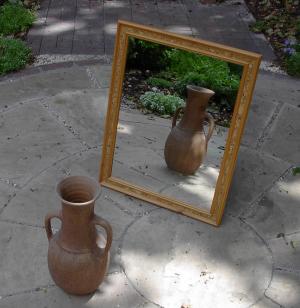
mirror, you see a "mirror image" or reflected image of yourself and your surroundings. This image is formed by the light emitted or scattered by objects, which then travels to the mirror, reflects off its surface, and finally enters your eyes. The remarkable effect is the illusion that these objects are located *behind* the mirror, or sometimes even in front of it, depending on the mirror's curvature.
This perception is due to the formation of a
virtual image. Unlike a real image (which can be projected onto a screen), a virtual image exists only as a point from which light rays *appear* to originate. Your brain, accustomed to light traveling in straight lines, interprets the reflected light as if it came from a source behind the mirror's surface. This is why, when you wave your right hand in front of a mirror, your reflection appears to wave its left hand – the image is laterally inverted, but otherwise a faithful representation. The reflection maintains the lines, contrast, sharpness, colors, and other image properties of the original scene, creating a very convincing, albeit illusory, duplicate.
Beyond Flat Surfaces: The World of Curved Mirrors
While the most common household mirrors are flat, or
plane mirrors, their cousins –
curved mirrors – introduce fascinating variations to the reflected image. A plane mirror consistently yields a real-looking, undistorted image, simply reversing it left-to-right. However, when the surface is not flat, a mirror can behave much like a reflecting lens, significantly altering the perceived image.
*
Concave Mirrors: These mirrors curve inward, like the inside of a spoon. Depending on the object's distance, they can magnify images (think shaving or makeup mirrors), produce inverted images, or even project real images. They are crucial in applications like telescopes, where they collect and focus light from distant objects, and in car headlights, where they concentrate light into a beam.
*
Convex Mirrors: Curved outward, like the back of a spoon, convex mirrors always produce smaller, upright, and virtual images. While they make objects appear further away, they offer a wider field of view. This property makes them invaluable as rearview mirrors in vehicles (especially on the passenger side) and in security systems for shops, allowing a broad area to be monitored.
Both types of curved mirrors manipulate light rays in unique ways, showcasing the versatility of reflection beyond simple self-inspection.
From Ancient Puddles to Modern Marvels: A Brief History of Mirror Technology
The concept of a mirror is as old as humanity's ability to perceive reflections. Natural mirrors, such as calm surfaces of water, have existed since prehistoric times, offering our earliest ancestors a glimpse of their own images. However, the intentional manufacturing of mirrors has a rich history spanning millennia.
The earliest known manufactured mirrors date back to around 6000 BCE in Anatolia (modern-day Turkey), crafted from polished obsidian. Similar obsidian mirrors later emerged in Central America around 600 BCE. The Bronze Age, around 4000–3000 BCE, saw the advent of metal mirrors, primarily made from polished copper or bronze. Rudimentary glass mirrors first appeared in Roman times around the 1st century AD, but these were often poor quality. High-quality glass mirrors, however, did not become widespread until the Renaissance, when Venetian artisans in Murano developed advanced techniques, often using tin-mercury amalgams for backing.
The modern silver-backed mirror, which provides superior reflectivity in the visible spectrum and is the standard we recognize today, was a breakthrough introduced in 1835 by German chemist Justus von Liebig. He pioneered a chemical reduction process using silver nitrate to deposit a thin, uniform layer of silver onto glass. Today, common household mirrors typically consist of a glass substrate coated with an ultra-thin layer of highly reflective metal, usually silver or aluminum. This delicate metallic layer is then protected by additional layers, often copper and paint, to prevent oxidation and abrasion. This intricate layering is what allows for the brilliant and durable reflection we take for granted. To delve deeper into this fascinating journey, read our article:
From Ancient Obsidian to Modern Glass: The Evolution of Mirrors.
The Enduring Importance of Mirrors in Daily Life and Beyond
Beyond their scientific principles, mirrors have profound practical applications that extend far beyond personal grooming. Indeed, their use for inspecting oneself, which dates back to prehistory, forms a strong overlap with their roles in decoration and architecture, where they can enhance light, create illusions of space, and add aesthetic appeal.
In modern society, mirrors are indispensable tools in a vast array of fields:
- Optics and Scientific Instruments: They are fundamental components in telescopes, microscopes, cameras, and laser systems, where they precisely direct and focus light to achieve specific objectives.
- Safety and Navigation: Rearview mirrors and side mirrors in vehicles, dental mirrors, and security mirrors enable us to see objects that would otherwise be out of our direct field of view.
- Technology: From projector systems and fiber optic communications to solar power collection and sophisticated medical devices, mirrors play critical roles in shaping and managing light.
- Art and Design: Beyond utility, mirrors are powerful artistic elements, used to create dynamic spaces, illusions, and captivating visual effects in art installations and interior design.
The versatility of mirrors, stemming from their ability to manipulate light so effectively, makes them a cornerstone of both ancient craft and modern innovation. For more on the diverse applications and underlying technologies, explore
Understanding Mirrors: Types, Materials, and Practical Uses.
Conclusion
The seemingly simple act of seeing our reflection in a
mirror is a testament to the elegant laws of physics governing light. From the precise angle of incidence equalling the angle of reflection to the preservation of light wave properties, every aspect of a mirror's function is rooted in scientific principles. Whether flat or curved, ancient or modern, the mirror remains a captivating marvel of engineering, transforming our perception of reality and continuing to be an indispensable tool across countless facets of human endeavor. The next time you glance into a mirror, remember the intricate science and rich history behind that clear, reflective surface.